GSTN Predictive Binary Classification
Machine Learning • Competition Finalist
GSTN AI/ML Analytics Challenge
Finalist Selection: Ranked among the top 17 finalist teams out of 200+ national participating teams as a single-member solo developer.
Architecture & ML Pipeline Flow
graph TD
    A["900,000+ Anonymized GST Records"] --> B["Data Integrity Validation (SHA256)"]
    B --> C["Pre-processing & Imputation (Median / Winsorization)"]
    C --> D["Class Imbalance Remediation (RUS + scale_pos_weight)"]
    D --> E["Stratified 5-Fold Nested Cross-Validation"]
    E --> F["Ensemble Modeling (XGBoost + LightGBM)"]
    F --> G["Threshold Tuning for F1 Optimization"]
    G --> H["SHAP Feature Interpretability Analysis"]
    H --> I["Competition-Compliant Model Artifact"]
Executive Overview
Developed for the Goods and Services Tax Network (GSTN) AI/ML Hackathon organized by the Government of India, this project engineered a high-throughput, interpretable binary classification pipeline for GST financial tax analytics.
The challenge required building an accurate predictive model $F_\theta(X) \to Y_{\text{pred}}$ over 900,000 real-world records characterized by severe class imbalance (91% majority / 9% minority) and extreme feature skewness, while adhering to strict zero-data-leakage compliance protocols.
Technical Challenges & Architectural Solutions
1. Severe Class Imbalance (91% / 9%)
- Challenge: Standard loss functions biased predictions toward the majority class, causing unacceptably low minority recall.
- Solution: Evaluated Random Under-Sampling (RUS), SMOTE, and tuned gradient boosted
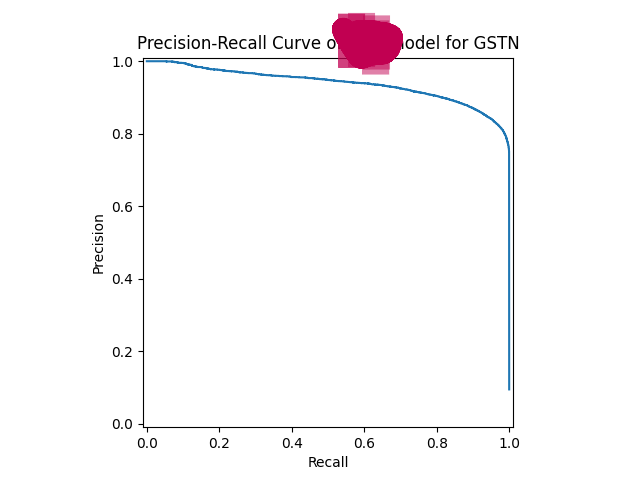
scale_pos_weightparameters to systematically optimize the Precision-Recall trade-off, maximizing both F1 and Matthews Correlation Coefficient (MCC).
2. Extreme Missingness & Heavy-Tailed Skewness
- Challenge: Multiple tax feature columns exhibited >50% missing values and extreme financial outliers.
- Solution: Applied strict feature pruning thresholds, robust median imputation, and two-sided Winsorization to normalize distribution tails without sacrificing variance.
3. Data Leakage & Generalization Safeguards
- Challenge: Risk of subtle data leakage across feature engineering and hyperparameter search.
- Solution: Enforced strict nested cross-validation and pipeline encapsulation (scikit-learn
Pipeline) ensuring preprocessing transformations were fitted exclusively on training splits.
Performance & Evaluation Metrics
| Evaluation Metric | Cross-Validation Score | Test Partition Score | Objective |
|---|---|---|---|
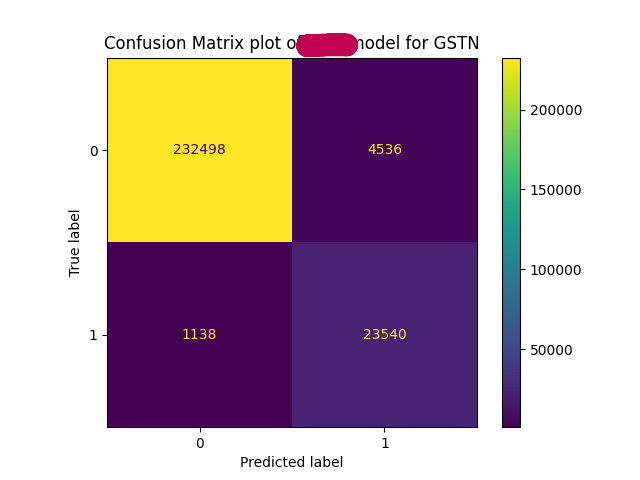
| Accuracy | 97.6% | ~97.8% | Global classification correctness |
| F1 Score | 0.884 | ~0.891 | Harmonic mean of precision and recall |
| MCC (Matthews Correlation) | 0.875 | ~0.880 | Balanced quality metric for imbalanced classes |
| ROC-AUC | 0.988 | ~0.990 | Separability threshold performance |
Diagnostic Visualizations
Precision-Recall Curve
Confusion Matrix
Verified Accreditation
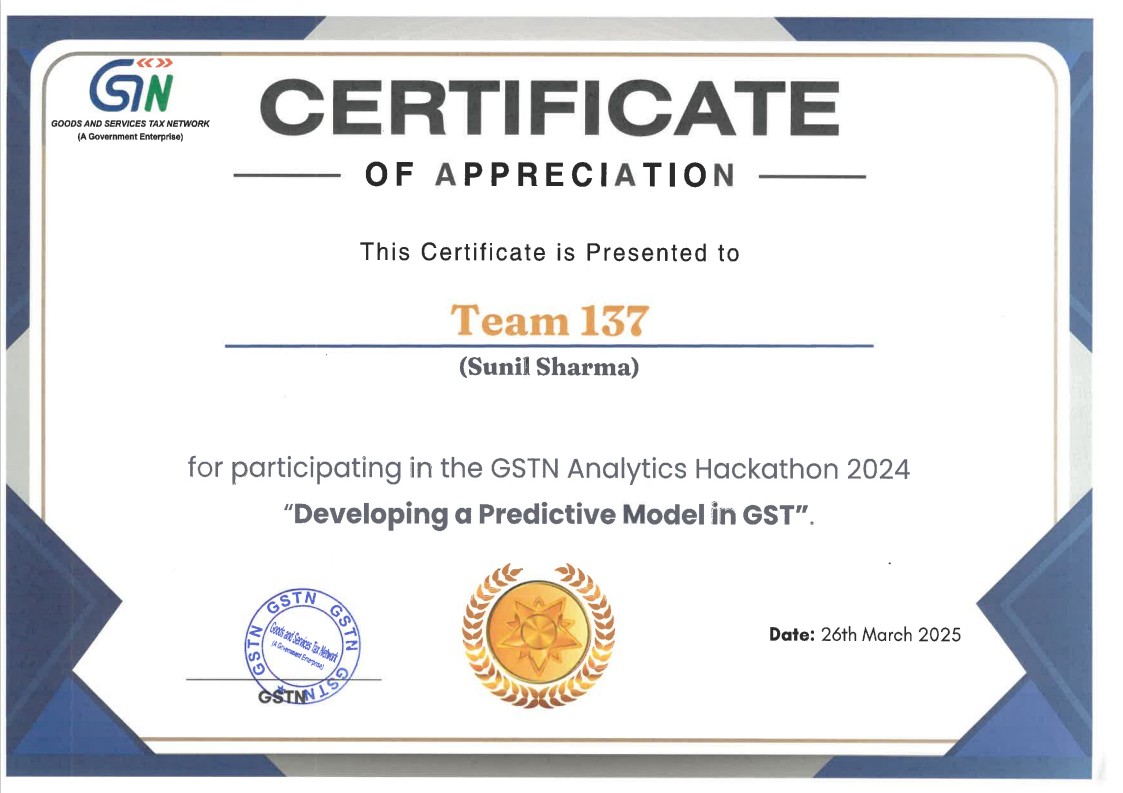
GSTN AI/ML National Hackathon Finalist • Awarded by Goods & Services Tax Network (GSTN)
Source Repository
- GitHub Repository — mrxsierra/gstn_dsp_pbc: Complete reproduction scripts, cross-validation benches, and documentation.